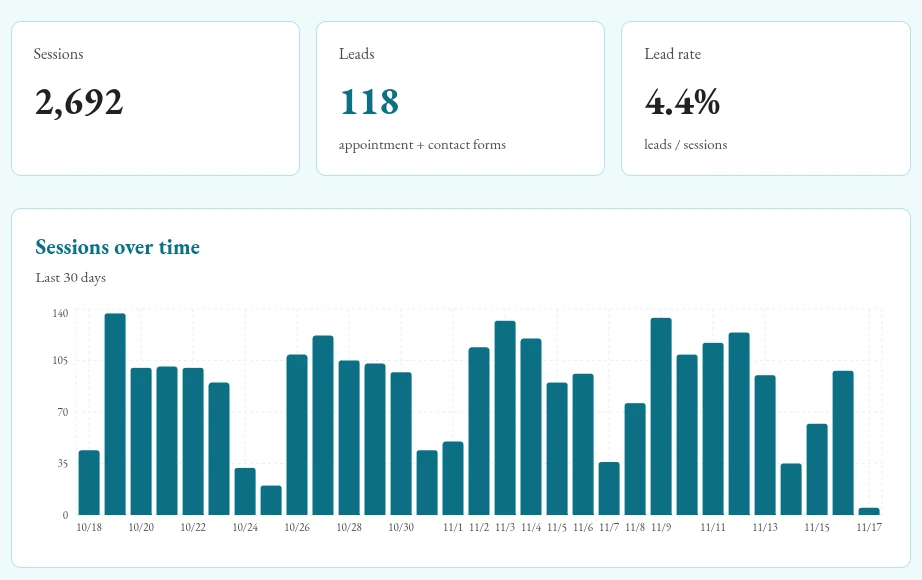
A few months ago, one of the practices we work with was getting a few website inquiries a week. Now it’s over two a day, weekends included. (Read the case study.)
We’re proud of that. What got them there works for most practices, and most of it is unglamorous work that doesn’t make a good sales slide.
Does every practice need more leads?
No. Most practice owners we talk to aren’t trying to grow. They want a full schedule, a team they trust and their evenings back. That’s a fine goal, and nothing below is a reason to change it.
This is for the owners who do want more: a second location, an associate, more patients helped, or just room to breathe financially.
Where do new patients actually come from?
Open your analytics and look at where your website leads start. In our case study, it was mostly Google search, with social media barely registering.
Your mix will be different. But for most independent practices, the website and search are where the bulk of new appointments start. That’s where the money and attention should go first.
Don’t cut corners on the thing that brings in most of your patients. A cheap website builder is fine for a hobby. For the front door of your practice, it gets expensive.
What does good infrastructure mean for a practice website?
Skip the buzzwords. Here’s what we look for:
- A signed BAA (business associate agreement, the contract that makes a vendor legally responsible for protecting patient data) with every vendor that touches form data. That includes the service that runs your forms, not only your email.
- Encryption on every page and form, and no patient details sitting in a website database or an email subject line.
- A CDN (content delivery network, copies of your site on servers close to each visitor) so pages load fast and stay up when one server has a bad day.
- Uptime monitoring that alerts someone when the site or a form breaks, before a patient finds out.
- Spam filtering so your team spends its time on real patients, not bots.
This never shows up in a design mockup, but it decides whether a patient’s request actually reaches you.
Is your website fast, accessible and clean?
Most patients find you on a phone, often while they’re stressed or in pain. A slow page, a tiny button or a form with 30 fields loses them.
We aim for pages that load in a couple of seconds on a phone, work with screen readers, and ask only for what the front desk needs to call back. The full intake paperwork can come later.
Are your online profiles lined up?
Your Google Business Profile, directory listings and website should all match: same phone number, same hours, same address, and links that land on the right page. Patients and search engines both lose trust when they don’t.
Which marketing channels need to be running?
Not all of them. Pick the one that brings in the most patients and keep it fed with new content every week. For many practices that’s the website’s blog or the Google Business Profile. One channel done well beats five done halfway.
How fast should you respond to a new inquiry?
Within an hour during business hours. A patient filling out your form is often filling out two or three others. The practice that calls back first usually gets the appointment.
Finish intake as quickly as you can. If your phone system, forms or EHR make that hard, set them up so they help: an instant alert to the right person, a text confirming you got the request, a booking link the patient can use right away.
How do you keep a project like this on track?
Meet weekly, or more often, until you hit the goal. Keep the meetings short, make decisions on the call, and don’t let anything wait a month on a reply.
And make sure everyone can see the numbers, ideally on a live dashboard of traffic and leads. When the owner, the office manager and the vendor all look at the same numbers, nobody has to guess whether something is working.
What breaks a tie when you’re not sure?
The patient experience. When you’re stuck between two options (a longer form or a shorter one, a chatbot or a callback), pick the one that’s easier for the patient. It usually brings in more appointments, too.
Key takeaways
- Put your budget where most new patients come from, usually the website and search.
- Get the infrastructure right: BAAs, encryption, a CDN, uptime monitoring and spam filtering.
- Call back within an hour, and keep the numbers where everyone can see them.
If you want more patients and aren’t sure where yours are getting lost, reach out. We’re happy to take a look, even if you’re not ready to grow yet.